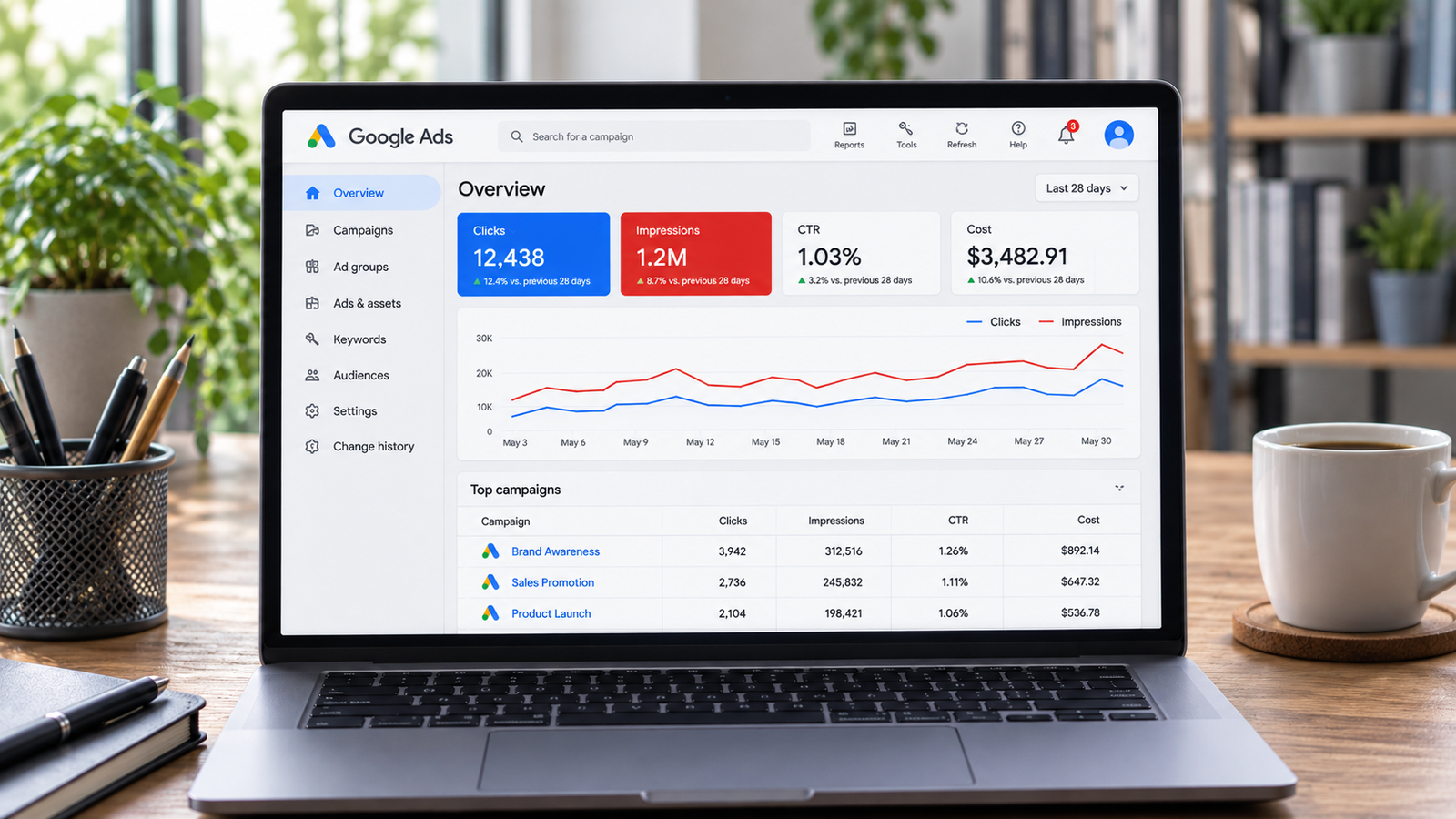
Google Ads can put your business in front of potential customers at the exact moment they are searching for a product, service or solution.
But simply creating a campaign and adding a budget does not guarantee strong results.
Successful advertising requires clear goals, accurate conversion measurement, relevant keywords, persuasive ads and landing pages that make it easy for visitors to take action.
The most effective Google Ads strategies focus on generating valuable business results rather than simply increasing clicks.
Whether you are managing campaigns yourself or working with a digital marketing agency, the following Google Ads strategies can help you build campaigns around better data, stronger targeting and measurable growth.
1. Build Google Ads Strategies Around Real Business Goals
One of the most important Google Ads strategies is deciding what success actually means before launching a campaign.
Many advertisers focus immediately on:
- Clicks
- Impressions
- Click-through rate
- Average cost per click
These metrics can be useful, but they do not necessarily tell you whether advertising is generating business.
A service company may care more about:
- Phone calls
- Contact form submissions
- Consultation bookings
- Qualified leads
An eCommerce company may focus on:
- Purchases
- Revenue
- Conversion value
- Return on advertising spend
Track Actions That Matter
Google Ads provides conversion measurement to help advertisers understand what users do after interacting with an advertisement, such as completing a purchase or generating a lead.
Google provides an official guide to setting up website conversions that can help businesses understand how conversion measurement works.
Without accurate conversion tracking, it becomes much harder to know which campaigns, keywords and advertisements are creating meaningful results.
Your Google Ads strategies should therefore begin with clearly defined conversion actions.
2. Structure Campaigns Around Search Intent
Campaign structure can have a major impact on how relevant your ads feel to potential customers.
Instead of placing every service and keyword into one large campaign, organize advertising around closely related themes.
For example, a digital agency might separate campaigns for:
- Website Development
- SEO Services
- Google Ads Management
- Shopify Development
- Social Media Marketing
A business providing local services might separate campaigns by service or location.
Why Search Intent Matters
Someone searching:
website development company
may have very different intentions from someone searching:
how to build a website myself
Both searches involve websites, but the first visitor may be considerably closer to hiring a company.
Successful Google Ads strategies consider the intention behind the search rather than targeting every remotely related keyword.
If your business needs help combining advertising with your website and broader marketing strategy, explore our digital marketing services.
3. Use Keywords and Search Terms Strategically
Keywords remain an important part of Search campaigns.
Google Ads currently supports broad, phrase and exact keyword matching, with the different match types determining how searches may be matched with your keywords.
However, choosing keywords when launching the campaign is only the beginning.
One of the most useful Google Ads strategies is regularly reviewing the actual searches that triggered your advertisements.
Review the Search Terms Report
Google’s Search Terms Report provides information about searches that triggered your ads and how those searches performed.
This information can help you identify:
- Relevant new keyword opportunities
- Searches generating conversions
- Low-quality search traffic
- Irrelevant terms
- New negative keyword ideas
Use Negative Keywords
Negative keywords allow advertisers to prevent ads from serving for certain unwanted words or phrases.
For example, a premium web development company may decide that searches containing terms such as:
- Free
- Course
- Tutorial
- Job
- Salary
are not appropriate for a lead-generation campaign.
Negative keywords should be based on your actual business goals and search-term data rather than simply copying a generic list.
4. Create Strong Responsive Search Ads
Modern Google Ads strategies should include high-quality responsive search ads.
Google’s responsive search ads allow advertisers to provide multiple headlines and descriptions. Google Ads then tests different combinations to determine which messages are most relevant in different situations.
You can read Google’s official responsive search ads guidance for additional information.
Write Headlines Around Customer Intent
Your ad should closely reflect what the potential customer searched for.
For example:
Weak headline:
Welcome to Our Company
Stronger headline:
Professional Website Development
A local business could make the message even more specific:
Website Development in Toronto
Highlight a Clear Benefit
Your advertisement should give potential customers a reason to click.
Benefits could include:
- Free consultation
- Custom solutions
- Fast turnaround
- Experienced team
- Transparent pricing
- Local service
- No-obligation quote
Only advertise benefits that your business genuinely provides.
Use a Strong Call to Action
Useful calls to action include:
Get a Free Quote
Book a Consultation
Call Our Team
Request Pricing
Start Your Project
A visitor should understand what they can do after clicking your advertisement.
5. Match Your Landing Page to Your Advertisement
Getting the click is not the final goal.
The landing page needs to continue the same conversation that began with the advertisement.
Google’s own guidance recommends aligning ads, keywords and landing-page content, noting that landing-page relevance contributes to the user experience and Quality Score considerations.
For more detail, review Google’s official landing page optimization guidance.
Avoid Sending Every Visitor to the Homepage
Imagine someone searches for:
Shopify development company
Your ad says:
Professional Shopify Development Services
But after clicking, the visitor reaches a homepage containing ten unrelated services.
They now have to search for the information they expected to see.
A dedicated Shopify landing page would usually create a clearer journey.
Keep Message Consistency
The keyword, advertisement and landing page should make sense together.
For example:
Search: Google Ads management
Advertisement: Professional Google Ads Management
Landing Page: Google Ads Management Services
This consistency is one of the most practical Google Ads strategies for improving the experience after someone clicks.
6. Use Conversion Data Before Making Major Decisions
Data should guide your Google Ads strategies.
Campaigns often generate large amounts of information, but not every metric deserves equal attention.
Consider looking at:
- Conversions
- Conversion rate
- Cost per conversion
- Conversion value
- Search terms
- Campaign performance
- Landing-page performance
A high click-through rate may look impressive, but if those clicks never become leads or customers, the campaign may still require significant improvement.
Understand Smart Bidding
Google’s Smart Bidding strategies use Google AI to optimize bids toward conversions or conversion value.
Google provides an official Smart Bidding guide for businesses that want to understand these automated bidding strategies.
Automation can be valuable, but the quality of the data provided to the advertising platform still matters.
If conversion tracking is incorrect, optimization decisions may be based on the wrong signals.
This is why measurement needs to come before aggressive automation.
7. Test and Improve Your Google Ads Strategies Continuously
Google Ads should not be treated as a campaign you create once and forget about.
Strong Google Ads strategies involve continuous review and improvement.
Areas worth testing include:
Ad Copy
Experiment with different:
- Headlines
- Benefits
- Calls to action
- Offers
- Value propositions
Landing Pages
Test elements such as:
- Headlines
- Form length
- CTA placement
- Trust elements
- Images
- Page speed
Keywords and Search Terms
Continue identifying:
- Valuable search terms
- Poor-quality searches
- Negative keywords
- New opportunities
Budget Allocation
Campaign budgets should reflect performance and business priorities.
Google Ads uses an average daily budget at campaign level, and Google provides tools and recommendations for managing campaign budgets.
Do not assume that increasing budget will automatically solve problems caused by weak targeting or poor landing pages.
Optimization should focus first on improving the quality of the advertising system.
How Google Ads Strategies and SEO Can Work Together
Google Ads and SEO are different marketing channels, but they can support each other.
Paid search can provide faster visibility for commercially important searches, while SEO focuses on building longer-term organic visibility.
For example, search-term information from advertising campaigns may reveal questions or services that could also become useful website content.
Likewise, a professionally developed website can support both SEO traffic and paid advertising visitors.
You can find additional website, advertising and SEO insights on the SRTech Consultant Blog.
What Metrics Should You Monitor?
The right metrics depend on your campaign goal.
For lead generation, consider monitoring:
- Leads
- Cost per lead
- Conversion rate
- Qualified lead quality
- Search terms
For eCommerce, useful metrics may include:
- Purchases
- Revenue
- Conversion value
- Cost per acquisition
- Return on advertising spend
Clicks and impressions provide context, but meaningful business outcomes should remain the priority.
Why Good Google Ads Strategies Require a Strong Website
Advertising can generate traffic, but your website determines much of what happens next.
Your landing page should:
- Load quickly
- Work on mobile devices
- Explain the offer clearly
- Build trust
- Provide visible contact options
- Include a clear CTA
Spending more money on advertising cannot completely compensate for a website that provides a poor user experience.
That is why the strongest Google Ads strategies connect advertising, landing-page development, analytics and conversion optimization.
Final Thoughts
Successful Google Ads campaigns require more than choosing a few keywords and increasing your budget.
The most effective Google Ads strategies combine:
- Clear campaign goals
- Accurate conversion tracking
- Relevant keywords
- Search-term analysis
- Strong responsive search ads
- Relevant landing pages
- Data-driven optimization
Google Ads continues to evolve, but the core objective remains the same: connect the right potential customer with a relevant offer and make it easy for that person to take action.
Businesses that continuously measure and improve their campaigns are in a stronger position to make informed advertising decisions.
Ready to Improve Your Google Ads Campaigns?
At SRTech Consultant, we combine Google Ads management, website development, SEO and digital strategy to help businesses build stronger online marketing campaigns.
Whether you need help launching a new campaign or improving an existing account, our team can help create Google Ads strategies around your business goals.